All posts
Using AI in Your Academic Work: A Practical Guide for Students Worldwide
Vinit S · 4 Nov 2026 · 6 min read
Ai paraphrasinghow to use ai in academicspaper writingresearch papers
The Principle: AI Is a Collaborator, Not a Ghostwriter
Universities worldwide are converging on one idea: you can use AI to support your thinking, but the thinking, argument and conclusions must be yours. A useful test is to ask whether you could defend every sentence in a viva or a one-on-one conversation with your supervisor. If not, the AI has done too much.
Policies differ between institutions, and sometimes between modules. Before you start, read your university’s AI policy and your assignment brief. If the rules are unclear, email your instructor. That one email can save you from an academic misconduct case.
Where AI Helps Most
Understanding difficult material. Paste a dense paragraph from a paper and ask for an explanation at undergraduate level, then ask for a quiz to test yourself. This builds understanding instead of replacing it.
Brainstorming and scoping. Ask for ten possible angles on a topic and the strengths and weaknesses of each. Then choose and justify one yourself.
Structuring. Ask for outline options for a literature review or a methodology chapter, then rewrite the outline in your own logic.
Feedback on your own drafts. Write first, then ask the model to act as a critical examiner: “Where is my argument weakest? What counterarguments am I missing?” This is one of the highest-value uses, and it keeps authorship with you.
Language polishing. For students writing in a second language, AI can fix grammar and clarity. Most institutions accept this, but check yours, and keep your own voice.
Prompting Techniques That Work
Give context and constraints. “I’m a second-year economics student writing 1,500 words on inflation targeting. Suggest three counterarguments to my thesis below” beats “write about inflation.”
Assign a role. “Act as a skeptical peer reviewer” produces sharper critique than a generic request.
Iterate. Treat the first answer as a draft. Ask follow-ups such as “What evidence would contradict this?” or “Explain step 3 more simply.”
Ask for reasoning, not just answers. “Show me how you got there” helps you spot errors.
Keep a prompt log. Save your prompts and the outputs you used. It is useful if you need to disclose your AI use, and it shows your process.
Verify Everything: Hallucinations Are Real
LLMs can invent citations that look convincing but don’t exist, and they can state wrong facts with total confidence. Never cite a source you haven’t opened yourself. Check every statistic against the original and look up every reference on Google Scholar or your library database. Treat AI output as a lead to verify, not as evidence.
Tools Worth Knowing
ChatGPT, Claude and Gemini for explanation, brainstorming and critique of your drafts.
Elicit and Consensus to find and summarize academic papers (always read the originals).
Scite to see whether later papers support or dispute a study.
NotebookLM to ask questions of your own uploaded sources.
Zotero or Mendeley for reference management, which still beats any chatbot for citations.
Grammarly or LanguageTool for proofreading.
An Illustrative Example
(This is a composite scenario, not a documented case.)
Priya, a master’s student, had four weeks to write a literature review on renewable energy policy. She used Elicit to surface 40 relevant papers in an afternoon, a task that would normally take days. She read the key 15 herself, then used an AI model to explain statistical methods she didn’t know. She drafted the review in her own words and asked the AI to critique it as a hostile examiner. It flagged that her section on policy outcomes ignored studies from developing economies. She added that research, verified every citation, and submitted with a short AI-use disclosure, as her university required.
The AI saved her time on searching, explaining and revising. The analysis and writing stayed hers, and that is why the work held up.
Using AI in Theses and Research Papers
Higher stakes mean more caution. For a thesis, AI is reasonable for literature mapping, checking the logic of your argument, summarizing your own notes, and debugging analysis code. It is risky for generating your findings, writing your discussion, or fabricating or “smoothing” data. Your supervisor and your ethics requirements matter here. If your work will be published, check the journal’s AI policy as well, since many require disclosure.
Disclose, Then Check Your Work Before You Submit
Transparency is your best protection. If your institution permits AI use, state which tool you used, for what, and what you did with the output. Many universities now provide disclosure templates.
Before you hit submit, give your work a final quality check. A few minutes here can be the difference between a confident submission and weeks of worry.
Proofread properly. Typos, inconsistent referencing and unclear sentences cost marks, even when the ideas are strong. Read your draft aloud, check that every citation matches your reference list, and make sure the voice sounds like you. Platforms like AssignOwl (assignowl.com) offer proofreading to catch what tired eyes miss.
Estimate where you stand. Grade prediction tools can give you a sense of how your work might score against typical marking criteria, so you can strengthen weak sections before your examiner sees them. Treat the result as feedback, not a guarantee.
Run an AI check. AI-detection tools such as the one on AssignOwl let you see whether passages in your draft read as machine-generated. If a section is flagged, don’t just tweak a few words. Go back to it, rewrite it in your own voice, add your own examples and analysis, and make sure you can explain every point. Detectors are imperfect and can flag genuine human writing, especially from non-native English writers, so a score is a prompt to revise, not proof either way. Keep your notes, outlines and draft history as evidence of your process.
Used together, these checks mean you submit work that is polished, original and defensible.
Final Takeaways
Learn your institution’s rules first.
Use AI to understand, plan and critique, not to replace your thinking.
Verify every fact and citation.
Keep a log of how you used AI and disclose it when required.
Proofread, check your AI-detection results and revise until the work is genuinely in your voice and you can defend it.
AI can make you a faster and sharper student. Just make sure the ideas and the learning are still yours.
Check your own draft before you hand it in.
Grade my assignmentMore from the blog
20 Nov 2026· 4 min read
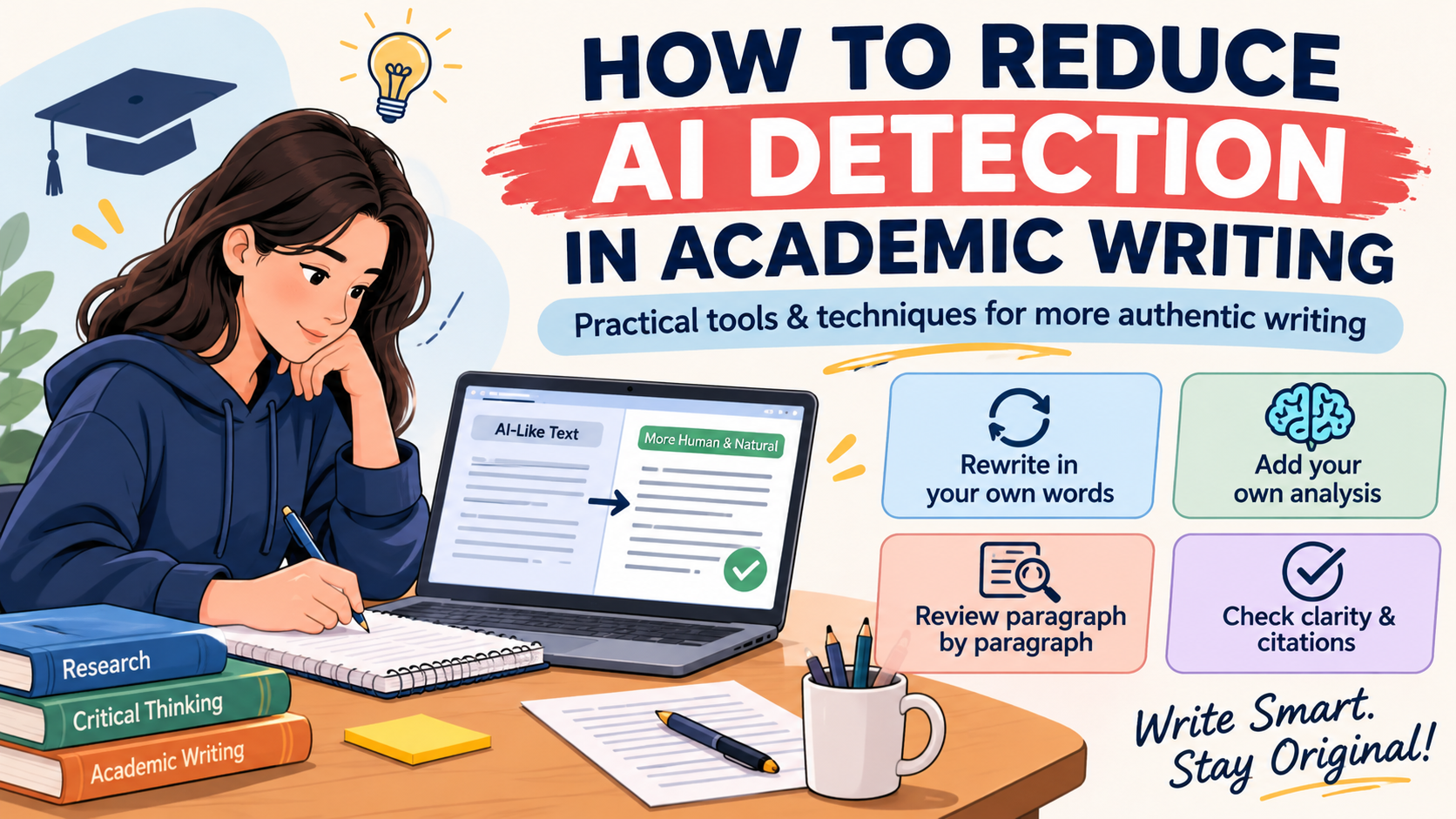
How to Reduce AI Detection in Academic Writing: Tools and Techniques Students Can Use
AI tools have become a part of academic writing, helping students brainstorm ideas, structure assignments, summarise research and improve grammar. However, with universities and publication houses increasingly using AI detection tools, students are also becoming concerned about how their submissions are evaluated. A high AI detection score doesn't necessarily mean a student has cheated. AI detectors can make mistakes, and even Turnitin acknowledges that its AI detection may misidentify human-written or AI-written text.

12 Nov 2026· 4 min read
Why Students Lose Marks Even When They Answer the Assignment Question Correctly: Understanding University Marking Rubrics
Discover why answering an assignment question correctly isn't enough to score high marks. Learn how university marking rubrics work and how to improve your academic grades.
10 Mistakes That Turn a B Essay Into a C
10 Mar 2026· 2 min read