All posts
How to Reduce AI Detection in Academic Writing: Tools and Techniques Students Can Use
Sachin Gupta · 20 Nov 2026 · 4 min read
AI detection in academic writinghow to reduce AI detectionreduce AI detection in essaysAI detection checkerAI humanizer toolshumanize AI textAI writing detectionTurnitin AI detectionAI detection in assignments
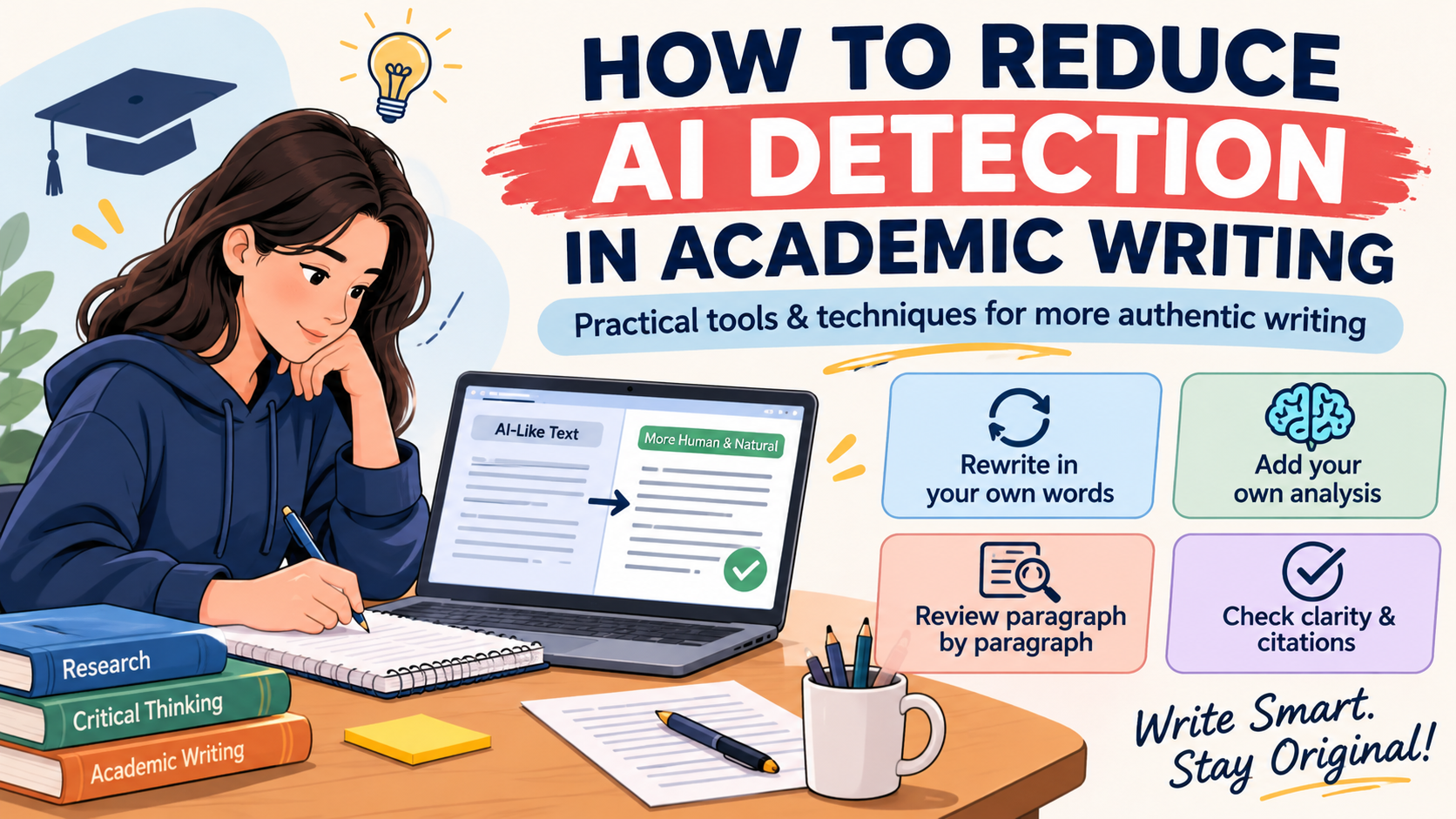
In this blog, we explore some specialised writing tools and practical techniques that can help students review and improve AI-assisted academic writing.
1. Explore specialised AI rewriting tools
While mainstream writing assistants are useful for grammar and paraphrasing, several specialised platforms offer dedicated text-rewriting features that students can explore when reviewing their drafts.
Walter Writes AI
Walter Writes offers rewriting and text refinement features, with an integrated AI detector to help review text. It is an option for students looking to improve sentence flow and review the readability of their writing.
Website: https://walterwrites.ai/
Humbot
Humbot combines AI rewriting with additional writing-related features, including detection and plagiarism-checking tools, depending on the available plan. Its integrated approach makes it worth exploring for students reviewing their drafts.
Website: https://humbot.ai/
HIX Bypass
HIX Bypass provides text rewriting capabilities within a multilingual AI writing ecosystem. It can be explored for reviewing phrasing, sentence structure and writing style across different languages.
Website: https://bypass.hix.ai/
StealthWriter
StealthWriter provides text transformation and rewriting features alongside AI detection tools. It offers different rewriting approaches that users can review and refine based on the context of their writing.
Website: https://stealthwriter.ai/
These tools should be treated as writing aids rather than guaranteed solutions to AI detection. Their output may require substantial editing to ensure that the original meaning, academic accuracy and appropriate referencing are preserved.
2. Rewrite sentences using your own understanding
One of the most effective ways to improve academic writing is to understand the ideas you're presenting instead of relying on sentences you don't fully understand.
Rather than simply replacing words with synonyms, revisit the idea and explain it in your own way.
Example:
Original sentence:
The implementation of technological advancements has significantly contributed to the transformation of educational methodologies in contemporary society.
Revised sentence:
Technology has changed how students learn, making online classes, digital resources and interactive learning more accessible.
The revised sentence is clearer, more specific and communicates the idea without unnecessary complexity.
Here are a few ways to improve your sentence-level writing:
Read and rewrite: Understand the idea, close the original text and explain it in your own words.
Use specific examples: Include examples from your research, observations, case studies or subject knowledge.
Avoid unnecessary vocabulary: Academic writing doesn't require complicated words in every sentence.
Use your own reasoning: Explain why a finding matters instead of simply repeating what a source says.
3. Edit your document paragraph by paragraph
If you've used AI to assist with an assignment, don't just run the entire document through a rewriting tool. Review each paragraph and make sure it reflects your understanding.
Introduction: Ensure the problem, context and research purpose are clearly explained in your own words.
Literature review: Compare studies, discuss differences and add your interpretation instead of merely summarising sources.
Methodology: Explain why you selected a particular research method, sampling approach or analytical technique.
Findings and discussion: Interpret the findings and connect them to your research questions and literature.
Conclusion: Summarise what you discovered and explain what your findings mean.
Reviewing your document section by section helps you identify generic statements, repetitive phrasing, unsupported claims and areas where your own analysis may be missing.
4. Make your writing reflect your research process
Academic writing becomes more authentic when it reflects the decisions you actually made while working on your research.
Include your own interpretation of research findings.
Explain the limitations of your study.
Keep drafts, notes, research records and revision history.
Use credible sources and cite them correctly.
Avoid generic filler sentences that add no meaningful information.
Follow your university's AI usage and disclosure policies.
These practices improve the quality of your work and help you demonstrate genuine academic understanding, rather than simply attempting to change a detection score.
5. Check your writing before submission
Before submitting your assignment, dissertation or research paper, review it for grammatical errors, clarity, academic tone, referencing issues and potentially AI-flagged sections.
If you don't have access to Turnitin, you can use AssignOwl to review your academic writing, check AI-related writing indicators and identify areas that may require further improvement. AssignOwl also helps students evaluate their work and improve the quality of their academic submissions.
AI detection results should always be treated as indicators rather than definitive proof of authorship. No detection tool can guarantee that a piece of writing will or will not be flagged.
Final takeaway
The best way to make academic writing sound human is to make it genuinely yours. Use AI tools for assistance where permitted, but let your own understanding, research, reasoning and interpretation drive the final document.
A well-researched and clearly written paper is far more valuable than one rewritten merely to chase a lower AI score..
Check your own draft before you hand it in.
Grade my assignmentMore from the blog

12 Nov 2026· 4 min read
Why Students Lose Marks Even When They Answer the Assignment Question Correctly: Understanding University Marking Rubrics
Discover why answering an assignment question correctly isn't enough to score high marks. Learn how university marking rubrics work and how to improve your academic grades.

4 Nov 2026· 6 min read
Using AI in Your Academic Work: A Practical Guide for Students Worldwide
AI tools are now part of how students research, plan and write. Used well, they cut weeks of friction out of academic work. Used badly, they put your degree at risk. This guide covers how to get the speed without giving up the authenticity of your work.
10 Mistakes That Turn a B Essay Into a C
10 Mar 2026· 2 min read
10 Mistakes That Turn a B Essay Into a C
Sometimes the difference between a B and a C isn’t about effort, it’s about small mistakes that weaken your essay. Avoiding these common issues can significantly improve your grades.